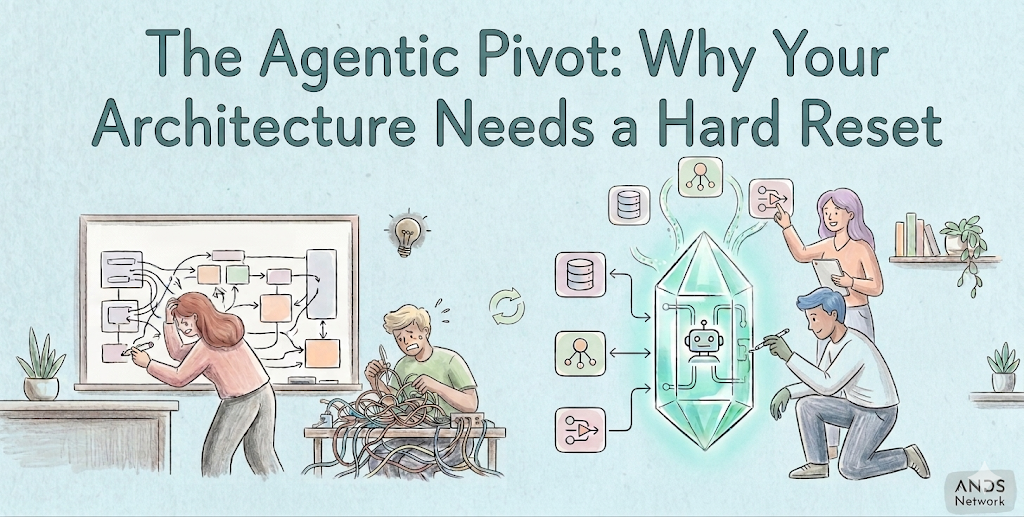
The current "conversational everything" paradigm is a transitional phase rather than a final destination. As AI agents evolve from basic chatbots into complex, multi-agent orchestrations, reliance on natural language for internal state transfer has emerged as a critical source of systemic instability. This research blog introduces the "Bifurcation of Intelligence," a methodology pioneered by ANDS Network designed to rigorously separate human-facing communication from high-speed machine-to-machine protocols.
By deploying a Sovereign Translation Layer, organizations can finally achieve the operational speed of distributed systems while maintaining the accessibility and trust of human-centric design. This approach effectively solves the reliability crisis facing today’s autonomous agent architectures. It moves beyond simple prompt engineering toward a structured systemic framework.
The Conversational Bottleneck: When Prose Fails
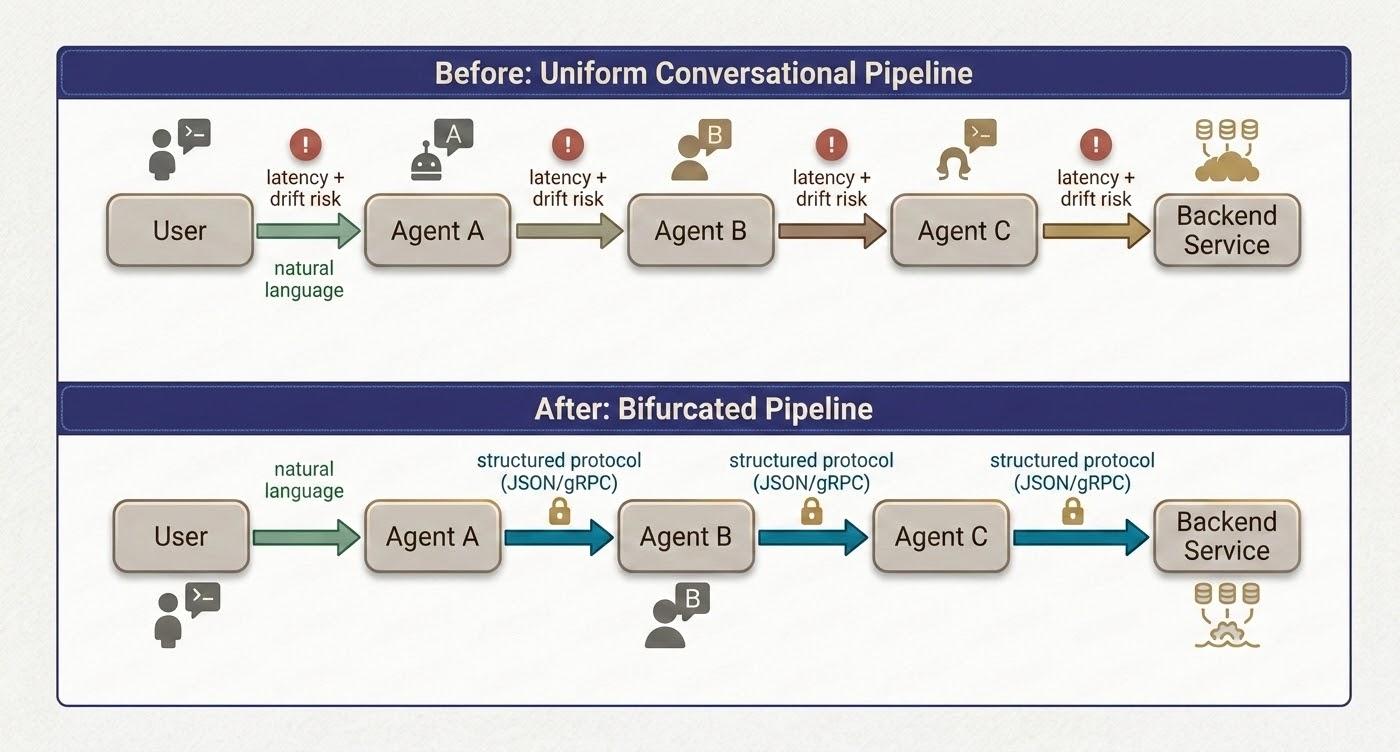
The default architecture for modern agentic systems rests on a fundamental fallacy: the belief that because humans communicate in prose, machines should emulate this behavior internally. In most current implementations, a user’s natural language request is decomposed by an orchestrator, and every subsequent exchange between sub-agents, databases, and microservices is translated back into prose. While intuitive during early prototyping, this creates a terminal architecture unable to scale under production loads.
It forces deterministic operations to behave probabilistically, resulting in what we call the Conversational Bottleneck. This is not a model capability issue; it is a structural failure inherent to the conversational medium itself. Internal machine logic requires a level of precision that prose cannot provide.
Natural language is inherently lossy and high-entropy, making it an inefficient substrate for machine-to-machine state transfer. Every instruction routed through a Large Language Model requires costly tokenization, generation, and re-interpretation. In a complex pipeline where a dozen agents must coordinate, these costs compound exponentially. Latency stacks linearly, while error probability driven by inevitable semantic drift stacks multiplicatively.
By the time an intent reaches the tenth hop, the original context is often diluted or distorted, leading to "hallucinations" that are actually architectural failures. A faster, smarter model cannot fix this because prose is simply not designed to carry a bounded, checkable state. We must therefore look toward structured protocols for internal coordination.
The Bifurcation: Human-AI Interaction (HAI)
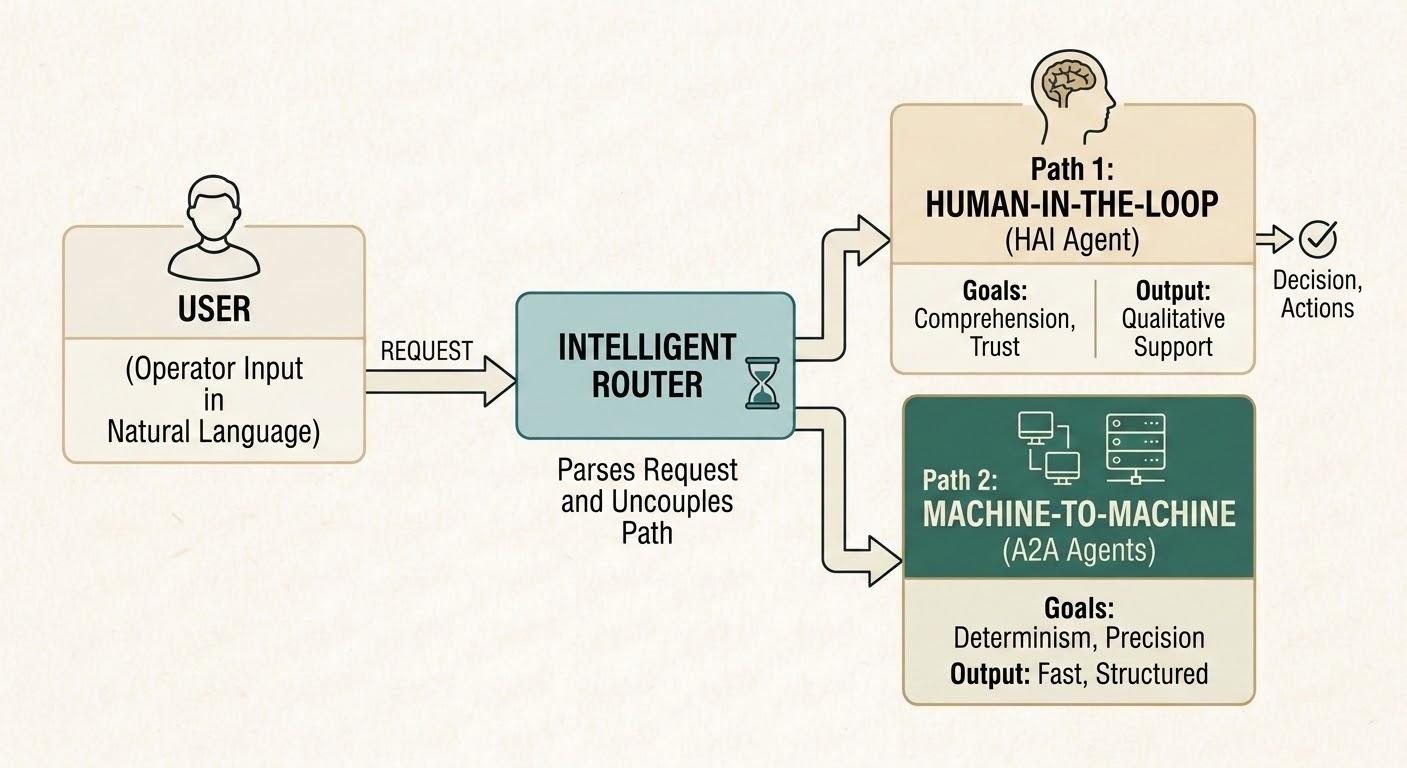
The resolution to the Conversational Bottleneck is a deliberate split of the interaction layer into two distinct protocols, each optimized for a specific consumer and failure tolerance. Human-AI Interaction (HAI) governs every exchange where a human is the immediate consumer. Its design objective is not throughput but comprehension and trust. A human operator does not need a payload optimized for parsing speed.
They require a response that is accurate, hedged, and legible without specialized tools. Ambiguity in HAI is a feature, not a bug; since qualified uncertainty is more trustworthy than false precision, the goal remains human understanding and decision support. This ensures that the human remains effectively in the loop without being overwhelmed by data.
The Bifurcation: Agent-to-Agent (A2A) Communication
Conversely, Agent-to-Agent (A2A) communication governs every exchange where the consumer is another machine process. Here, the design objective inverts completely. Latency is not a UX consideration but a hard system constraint, typically bounded by millisecond-level agreements. Ambiguity is strictly forbidden; a field that can be interpreted in two ways is a critical defect.
Payloads must be typed, schema-validated, and version-controlled using formats like JSON or gRPC. Because these protocols fail loudly and immediately when malformed, they ensure the determinism and throughput required for reliable systems. Boring, predictable architecture is the highest compliment a machine protocol can receive for performance.
The Protocol-First Methodology: Performative Logic
Separating HAI from A2A is necessary but insufficient; the harder problem lies at the translation boundary. ANDS Network addresses this through "Performative Logic." Drawing on speech-act theory, this method classifies utterances not just by content, but by their function: a request, a commitment, a confirmation, or a refusal.
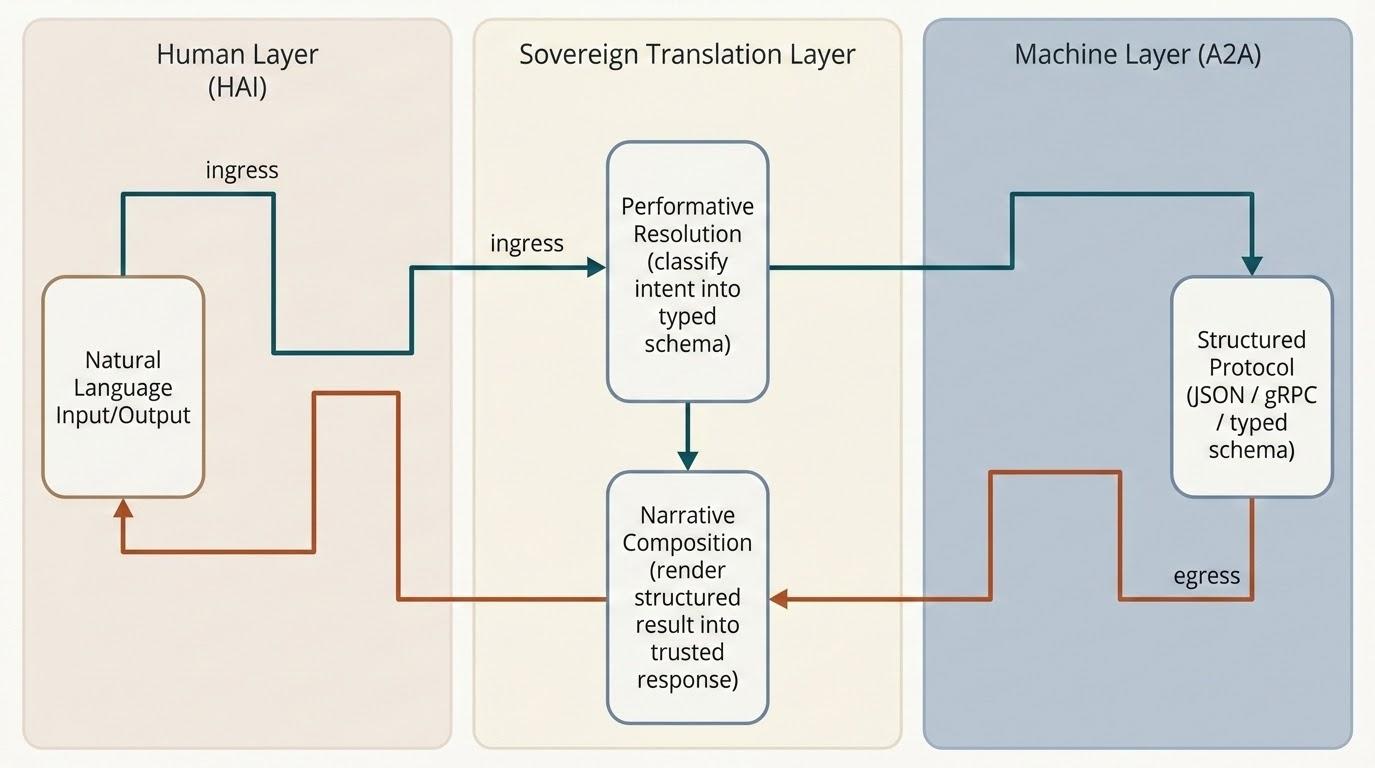
Before natural language crosses into the A2A layer, it must be resolved into one of these closed "performative types," which map to pre-defined schemas. An instruction is never passed downstream as raw prose. Instead, it is classified by its illocutionary function and encoded into a structured payload for immediate machine execution, ensuring precision.
This methodology applies in reverse at the egress boundary. A structured result returning from the A2A layer, such as an error code or status update, is never surfaced to the human as raw JSON. It is re-composed through a dedicated generation step into a response calibrated for clarity and trust. The structured object serves as the single source of truth, while the natural language is merely a rendering of that object, not the source itself. This strict ordering structure first, language as a secondary rendering layer is the methodological commitment that makes the bifurcation operationally real rather than merely conceptual for systemic reliability.
The Sovereign Translation Layer
ANDS Network organizes its research around the translation boundary, termed the Sovereign Translation Layer. "Sovereign" denotes that this layer maintains independent authority over the semantic correctness of translations, rather than deferring that responsibility to the endpoints. A conversational front-end does not get to assume its phrasing has been resolved into a schema; the layer validates this resolution against a registry before execution. Similarly, a backend service cannot return raw payloads to a human; the layer ensures narrative composition is calibrated for trust. Sovereignty means the boundary is a governed checkpoint, ensuring neither the human nor the machine layer dictates the other incorrectly.
Conclusion and Key Takeaways
The transition from experimental AI to production-grade autonomous systems requires a fundamental departure from uniform conversational architectures. The Bifurcation of Intelligence provides the roadmap for this transition, ensuring agents are as reliable as traditional software while remaining as accessible as the humans they assist. By adopting a protocol-first methodology and implementing a Sovereign Translation Layer, developers can effectively eliminate the conversational bottleneck. This architecture ensures that machines speak the language of precision, while humans continue to receive the language of trust. Ultimately, the future of AI advancement lies not just in smarter models, but in more disciplined, robust architecture for enterprise deployments.