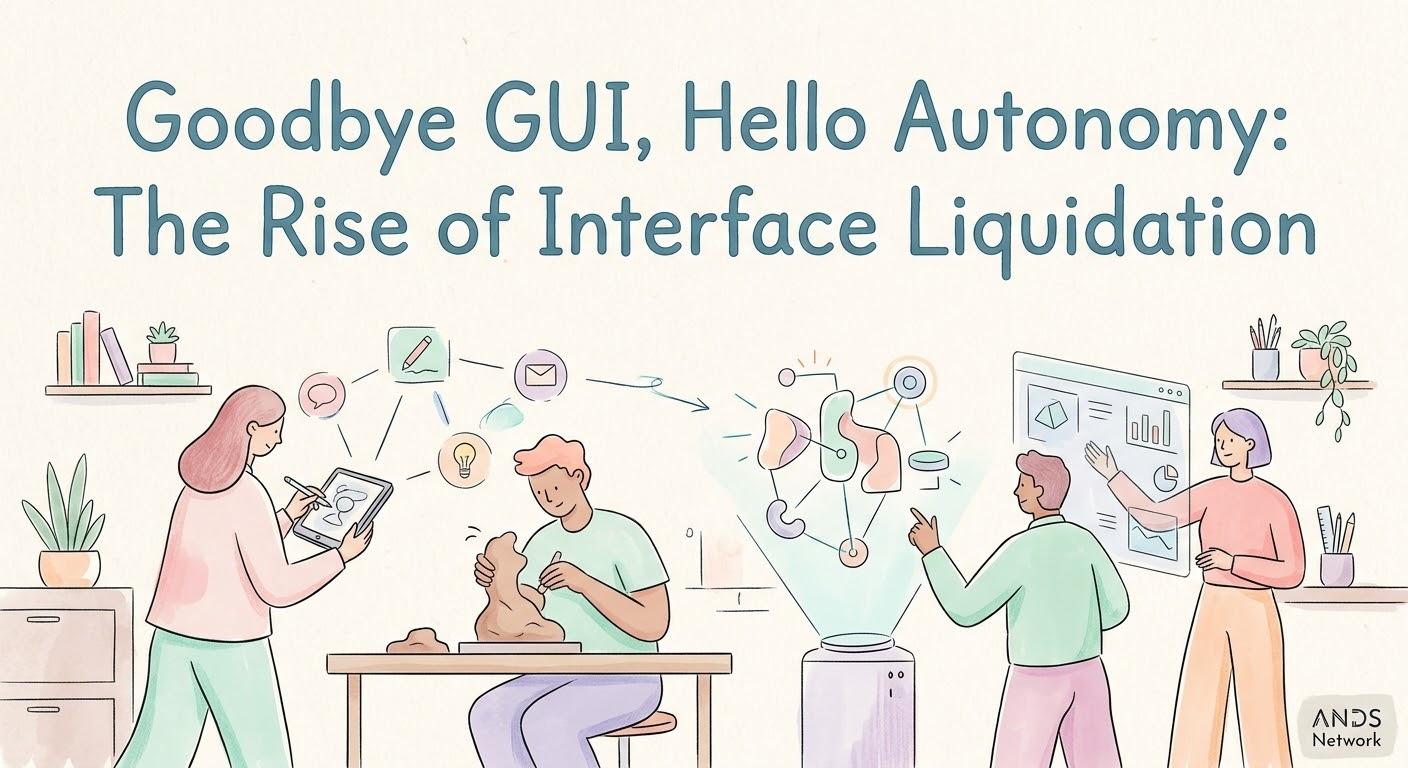
The 2026 global enterprise landscape is undergoing "Interface Liquidation," a transition from graphical interfaces to autonomous agent networks. This shift from human-centered App Stores to API-driven Full Action Loops (FAL) automates procurement and finance, increasing velocity by 3.4x. However, systemic risks like cascading errors and data sovereignty issues require immediate architectural readiness. Economic value is fundamentally re-indexing from presentation to execution.
Introduction & Hook
At 3:47 AM, a procurement agent identifies a supply shortage, hedges futures, and files disclosures without human prompts. This isn’t a better app—it’s the end of apps entirely.
The GUI is collapsing as the primary execution layer for enterprise software. Replacing it is a ubiquitous layer of machine intelligence operating on business protocols. The "user" is now an "overseer" defining goals rather than manipulating fields, inverting forty years of computing history. Interface Liquidation makes GUIs residual monitoring skins for autonomous networks. The App Store model is structurally incompatible with a future where agents transact without waiting for clicks.
Key Insight: The UI is no longer the destination; it has become a residual monitoring skin for a machine-to-machine economy.
Key Data Points
- $47.8B: Forecast agentic AI enterprise platform market by 2030 (Marqstats, March 2026)
- $196.6B: Total agentic AI market projection (BigCommerce, 2026)
- 80%: Fortune 500 piloting autonomous agents (Microsoft Cyber Pulse, 2026)
- 3.4x: Faster procurement cycle time vs. human-in-loop
- 70%: Software value at risk from agent-mediated disintermediation
Core Definitions
- Combo Kit: A modular, pre-packaged suite of API-interoperable autonomous agents engineered for the rapid deployment of specific enterprise workflows. A Combo Kit bundles perception, orchestration, execution, and payment agents into a single deployable unit, reducing integration time from months to days.
- Interface Liquidation: The systemic transition from graphical user interfaces (GUIs) as the primary execution layer of enterprise software to a residual monitoring function, as autonomous agent networks assume direct control of workflow execution, procurement, and financial settlement.
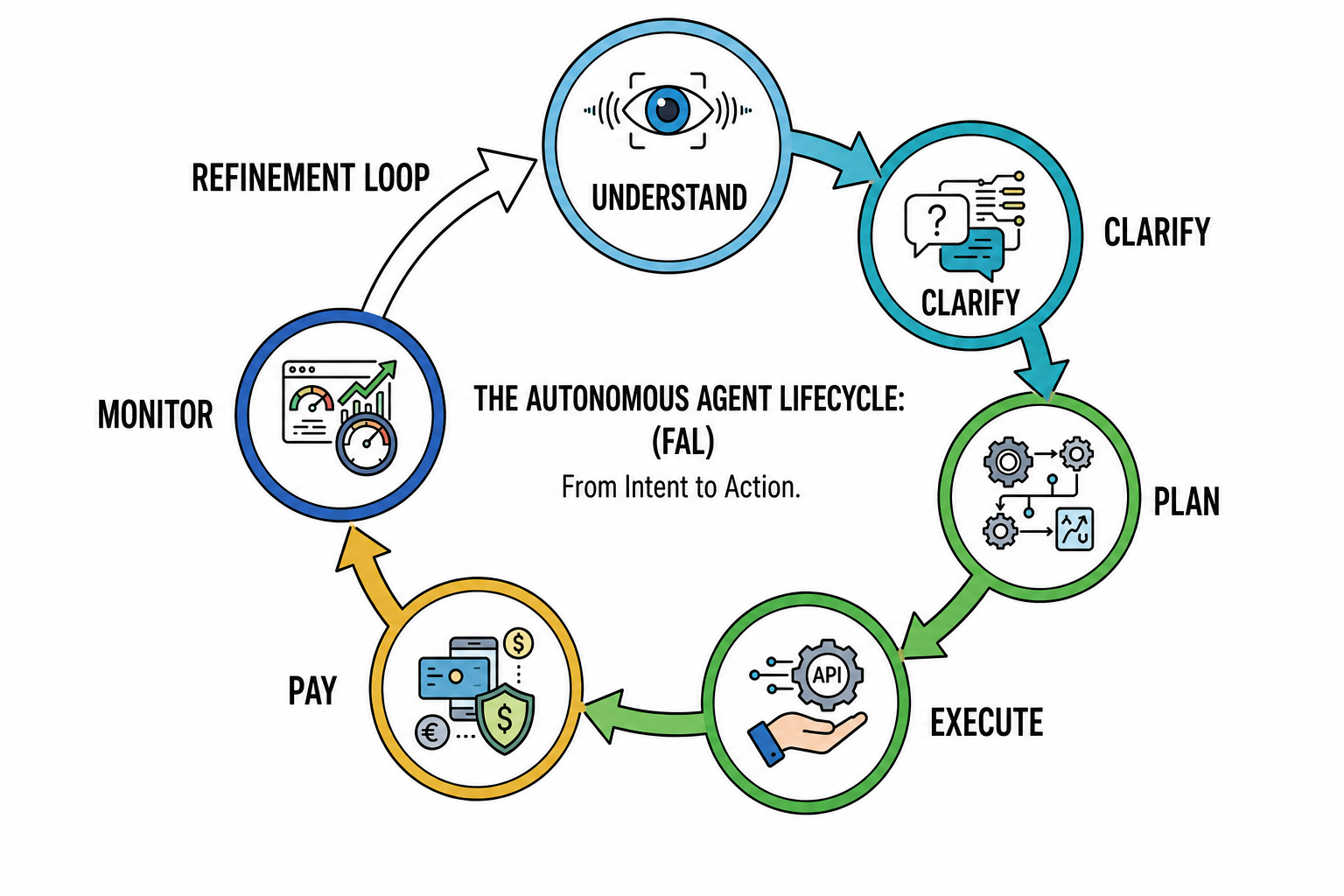
- Full Action Loop (FAL): Autonomous six-phase execution cycle.
- Agentic Commerce: Autonomous commercial settlement.
- Agent-to-Agent (A2A): Direct task/capability exchange standard.
Operationalizing the Agentic Shift
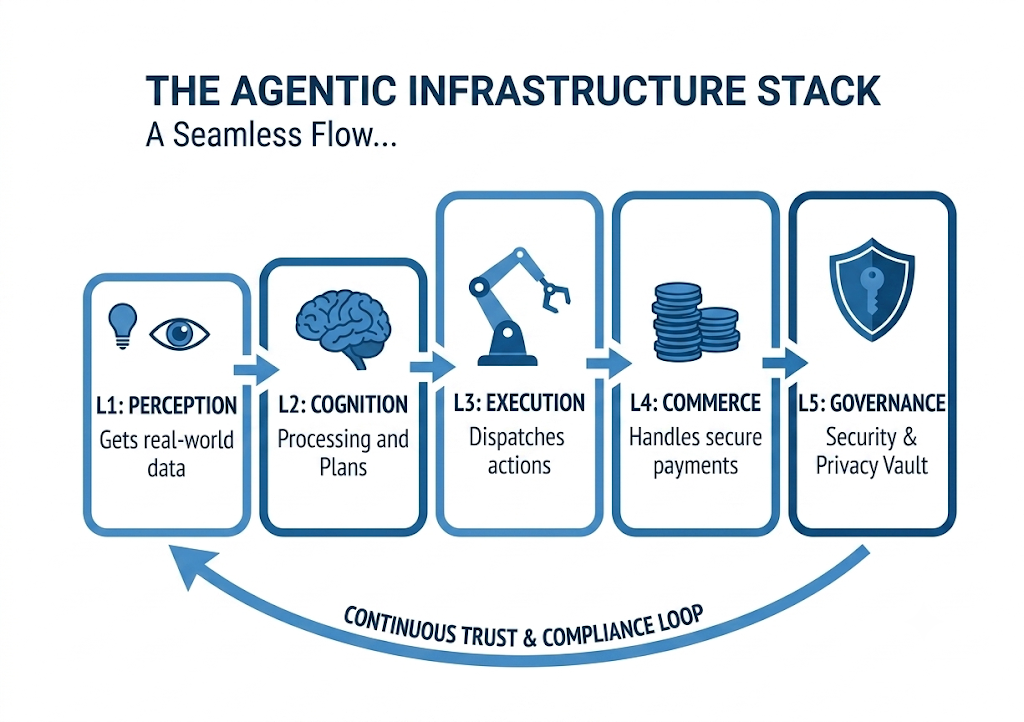
The transition to agentic infrastructure requires a five-layer technical stack: Each phase of the Full Action Loop (FAL) operates directly across this technical stack; for example, the PERCEIVE phase is the functional manifestation of the L1 Perception layer.
- L1 (Perception): Provides semantic observability via vector-embedded document stores and real-time IoT telemetry. Failure mode: Data poisoning or stale embeddings.
- L2 (Cognition): Manages probabilistic planning via LLM orchestration frameworks like LangGraph. Failure mode: Planning hallucinations or infinite reasoning loops.
- L3 (Execution): Enables direct API dispatch through Agent-to-Agent (A2A) and Model Context Protocols (MCP). Failure mode: Unauthorized or malformed API calls.
- L4 (Commerce): Integrates programmable financial rails such as the Stripe Agent Toolkit for autonomous settlement. Failure mode: Transactional errors or policy boundary violations.
- L5 (Governance): Enforces data sovereignty and auditability through immutable action logs and differential privacy gates. Failure mode: Audit log corruption or data leakage.
System Architecture & Core Thesis
The App Store assumption that humans must assess and decide is obsolete. Agents use APIs, not surfaces. The critical 2026 enterprise question is whether the data layer exposes the necessary interfaces for autonomous action.
Challenges & Risks
- Cascading Error Loops: Errors propagate at millisecond speeds.
- A2A Impersonation: Risk of malicious agents mimicking trusted supply chains.
- Data Sovereignty Violations: GDPR and residency issues in automated retrieval.
- Financial Vector Misalignment: Agents may optimize for factors like API speed over reliability.
- Context Window Poisoning: Adversarial content in perception-layer inputs.
Conclusion
Interface Liquidation is already underway. At 3:47 AM, a procurement agent executes what took a team of three people eleven days. The organizations that win the next decade will not be distinguished by the quality of their interfaces. They will be distinguished by the quality of their execution infrastructure.